
How to Store Diabetic Test Strips and Supplies Before Selling Them
Posted on May 07, 2026 at 06AM
If you have unused diabetic test strips or extra diabetic supplies sitting around, you may already know that you can sell them for cash. But here’s something many sellers overlook: how you store your test strips before selling them matters enormously. Poor storage can damage the strips, void their accuracy, and ultimately reduce your payout, or get your order rejected entirely.
In this guide, we’ll walk you through exactly how to store diabetic test strips and supplies so they arrive in perfect condition and you get the highest possible payout. Whether you’ve just switched meters, your insurance changed, or a loved one has passed, these tips will help you maximize the value of your unused supplies.
Why Proper Storage Is Critical Before You Sell
Diabetic test strips are medical devices, and they’re sensitive ones. Even if the box is factory sealed and unexpired, improper storage can degrade the strips and make them unsellable. Buyers like More Cash For Test Strips inspect every box carefully before processing payment. Damaged or compromised strips will be rejected, costing you time and money.
Before you even think about filling out the sales form, make sure your supplies have been stored correctly. Here’s what you need to know.
The Golden Rules for Storing Diabetic Test Strips
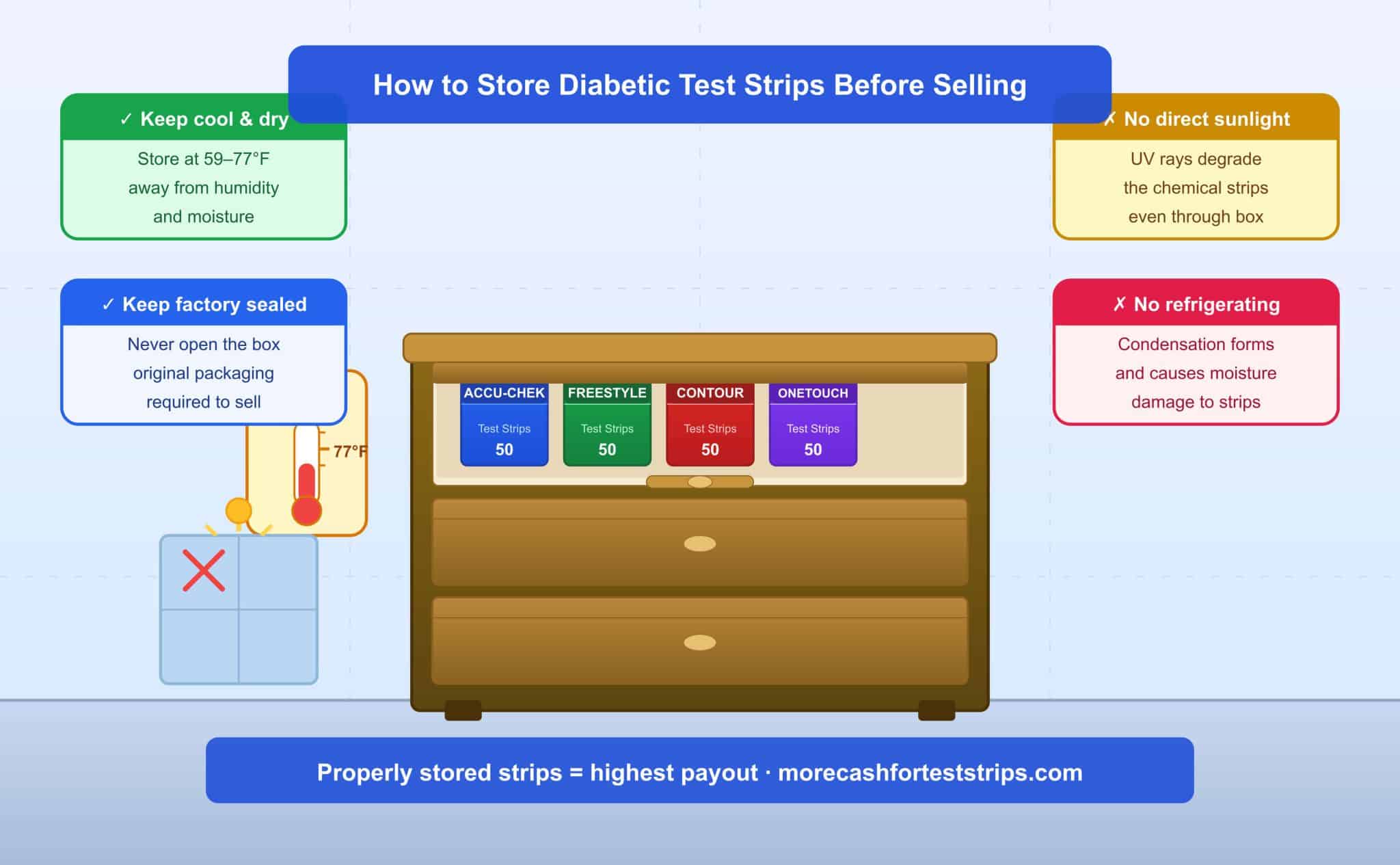
1. Keep Strips in Their Original, Factory-Sealed Box
This is the most important rule. Test strips must remain in their original, unopened, factory-sealed packaging to be eligible for resale. Once a box has been opened, the strips are no longer acceptable. Do not open boxes, remove strips, or break the seal for any reason if you plan to sell them.
- Do: Keep boxes sealed and in their original packaging at all times.
- Don’t: Open a box to check the strips or remove a few for personal use if you want to sell the rest.
2. Store at Room Temperature (59°F–77°F / 15°C–25°C)
Test strips are highly sensitive to temperature extremes. Both heat and cold can damage the chemical coating on the strips, rendering them inaccurate and unsellable. The ideal storage temperature is between 59°F and 77°F (15°C–25°C), essentially normal room temperature.
- Avoid storing strips near windows, radiators, or heating vents
- Never leave them in a hot car, garage, or attic
- Don’t refrigerate or freeze strips; cold and condensation cause damage
- Keep them away from direct sunlight
3. Protect Strips from Humidity and Moisture
Moisture is one of the biggest enemies of diabetic test strips. High humidity can cause the reactive chemicals in the strips to break down, even if the box appears sealed. In fact, humidity damage is one of the leading reasons strips fail inspection.
- Store strips in a cool, dry location
- Avoid bathrooms (steam and humidity from showers can seep through packaging)
- Keep away from kitchen areas where steam and moisture are common
- If you live in a humid climate, consider a climate-controlled room or storage area
4. Avoid Direct Sunlight and UV Exposure
UV rays can degrade the chemical reagents on test strips even through the box. Always store your supplies in a dark, cool location away from windows and direct light. A drawer, cabinet, or closet shelf is ideal.
5. Don’t Stack Heavy Items on Top of the Boxes
While this may seem obvious, it’s worth mentioning. Crushed or damaged boxes are rejected. Even if the strips inside are fine, a dented, torn, or squashed box will reduce their value or make them ineligible for sale. Stack boxes neatly and don’t place heavy objects on top of them.
6. Check the Expiration Date Before Storing
Before setting strips aside for sale, always check the expiration date on the box. Strips that expire within a few months may receive a reduced payout or not be accepted at all, depending on the buyer. More Cash For Test Strips pays based on brand, quantity, and expiration, so knowing your dates helps you get an accurate quote upfront.
How to Store Other Diabetic Supplies Before Selling
Beyond test strips, you may also have other diabetic supplies worth selling. Things like CGM receivers, insulin pumps, lancets, and more. Here’s how to properly store each:
Dexcom G6 / G7 Receivers and CGM Supplies
If you’re looking to sell your Dexcom G6 receiver for cash, store it in its original packaging at room temperature. Keep it away from moisture and avoid dropping it. Charge it to roughly 50% battery before shipping to preserve battery health.
Omnipod and Insulin Pump Supplies
Omnipod pods and related supplies should be stored in a cool, dry place and kept in their original sealed packaging. If you have Omnipod DASH or Omnipod 5 pods, follow the same rules: no heat, no moisture, no broken seals. Check our guide on selling Omnipod test strips for cash for more details.
Lancets and Lancing Devices
Lancets are a bit more resilient but should still be stored in a dry environment in their original packaging. Any lancing device should be kept clean and free of damage.
Common Storage Mistakes That Cost You Money
Many sellers lose money because of avoidable storage mistakes. Here’s a quick list of what NOT to do:
- Leaving strips in a hot car: Even for a few hours can destroy them
- Storing supplies in the bathroom: Humidity and steam cause damage
- Breaking the seal “just to check”: Opened boxes are not eligible for sale
- Ignoring expiration dates: Expired or near-expired strips may be declined
- Piling heavy items on top: Crushed packaging is rejected
- Keeping strips in the fridge: condensation when removed causes moisture damage
For more tips, read our post on common mistakes to avoid when selling diabetic test strips online.
Why Sealed Boxes Matter When Selling Diabetic Test Strips
We want to reinforce this because it’s that important: sealed boxes are non-negotiable. The resale market for diabetic test strips depends on the buyer being able to guarantee the integrity of the product to end users who often can’t afford retail prices. An opened box cannot be resold with confidence.
Read more about why sealed boxes matter when selling diabetic test strips to fully understand the inspection process.
How to Prepare Your Strips for Shipping After Storage
Once you’ve confirmed your strips are properly stored, it’s time to get them ready to ship. Here’s a quick overview:
- Step 1: Visit the Price List page and enter your brands and quantities for an instant quote.
- Step 2: Fill out the online sales form to request a free prepaid shipping kit or prepaid mailing label. No out-of-pocket cost to you.
- Step 3: Pack your sealed, undamaged boxes carefully with adequate cushioning.
- Step 4: Drop off at your post office and wait for fast payment via check, PayPal, Cash App, Zelle, or wire transfer.
For a complete walkthrough, see our step-by-step tips for selling diabetic supplies online in 2026.
Best Time to Sell Your Stored Test Strips
Don’t wait too long after storing your strips. Expiration dates sneak up fast. Ideally, sell within 6–12 months of receiving the strips, while they still have ample time before expiration. Strips with more than 6 months remaining on their expiration date typically fetch the highest payouts.
Read our full guide on the best time to sell your unused diabetic test strips online for detailed timing strategies.
Ready to Sell? Here’s Why More Cash For Test Strips Is the Best Choice
Once your diabetic test strips and supplies are properly stored and ready to go, the next step is finding a trusted buyer who pays top dollar. More Cash For Test Strips has been in the business for nearly a decade, holding an A+ rating with the Better Business Bureau and a 4.9-star rating on Trustpilot from hundreds of verified customers.
Here’s what makes us different:
- Highest payouts in the industry: Compare our rates before you sell
- Free prepaid shipping kit: No cost to you to send your supplies
- Fast payment: Same-day payment via PayPal, Zelle, Cash App, check, or wire
- We buy all major brands: Accu-Chek, Contour, FreeStyle, OneTouch, Dexcom, and more
- No hassle: Simple online form, free shipping, and quick turnaround
Ready to turn your properly stored supplies into cash? Get your free instant quote today. It only takes a minute.
Frequently Asked Questions About Storing Diabetic Test Strips
Can I store test strips in the refrigerator?
No. Refrigerating test strips is not recommended. When you remove them from the cold, condensation can form and cause moisture damage, even if the box is sealed. Always store at room temperature.
How long can I store unused diabetic test strips before selling?
You can store them as long as needed before the expiration date, as long as you follow proper storage conditions. However, for the best payout, sell your strips while they still have at least 6 months before expiration.
Do I need the original box to sell test strips?
Yes. Test strips must be in their original, factory-sealed packaging to be eligible for resale. Loose strips or opened boxes are not accepted.
What brands of test strips can I sell?
More Cash For Test Strips buys all major brands including Accu-Chek, FreeStyle, OneTouch, Contour, Dexcom, Omnipod, and more. Visit the price list to see all accepted brands.
Final Thoughts
Knowing how to store diabetic test strips and supplies before selling them is the difference between getting a full payout and getting your order rejected. The rules are simple: keep boxes sealed, store at room temperature, avoid humidity and sunlight, and don’t wait too long. Do all of that, and you’re set up for a smooth, profitable sale.
When you’re ready, More Cash For Test Strips is here to make the process as fast, easy, and lucrative as possible. Start with a free quote on our price list page, and let us handle the rest
